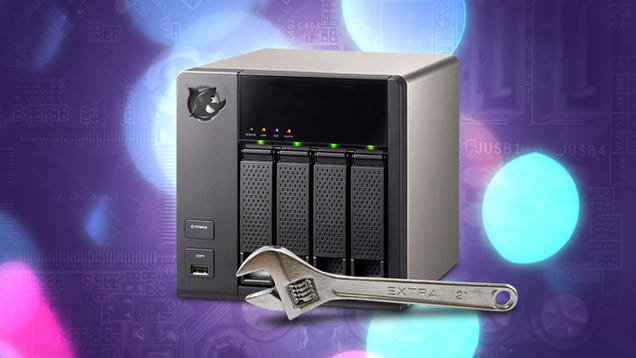
Turn an Old Computer Into a Do-Anything Home Server with FreeNAS 8

Turn an Old Computer Into a Do-Anything Home Server with FreeNAS 8You've heard the word "server" thrown around a lot, but usually in the context of web sites or big companies that have a lot of data to store. In reality, a server can be just as useful in your home. In this guide, we'll walk through how to create your own home server out of an old or cheap computer that can do all your downloading, streaming, and backup tasks 24/7.

Note: If this post looks familiar, it's because we've covered FreeNAS before. Our old guide used FreeNAS 7, which is great, but the new FreeNAS 8 makes installing plugins for BitTorrent, media streaming, Usenet, and other tasks much easier. If you want to check out FreeNAS 7—now called NAS4Free—you can still view our old guide here. Alternatively, if you don't want to use FreeNAS, you can put together a similar setup using Ubuntu.

What Does a NAS or Home Server Do?

Network Attached Storage—or NAS for short—is basically a set of hard drives connected to your network, so any computer in your house can access them. This is great for bigger households or people with multiple computers (like a home theater PC) that all need to access the same data. They're also usually quite low power and low cost, and they don't require a monitor, mouse or keyboard—once you've installed the software, you can configure every aspect of your NAS from a web browser on your other computers. read more details>>>

How to Setup a CCTV DVR for remote viewing online by PC Mac & smart phone internet Access

In this video we have explained how to access CCTV DVRs via web. Port forwarding and firewall rules are explained. We have shown port forwarding on BT Hub and Edimax Router for three well known brand DVRs, Avtech, Dahua and Hikvision. 

Courtesy of securiguide from youtube

What is CCTV?


Closed-circuit television (CCTV) is the use of video cameras to transmit a signal to a specific place, on a limited set of monitors. It differs from broadcast television in that the signal is not openly transmitted, though it may employ point to point (P2P), point to multipoint, or mesh wireless links. Though almost all video cameras fit this definition, the term is most often applied to those used for surveillance in areas that may need monitoring such as banks, casinos, airports, military installations, and convenience stores. Videotelephony is seldom called "CCTV" but the use of video in distance education, where it is an important tool, is often so called.[1][2]

In industrial plants, CCTV equipment may be used to observe parts of a process from a central control room, for example when the environment is not suitable for humans. CCTV systems may operate continuously or only as required to monitor a particular event. A more advanced form of CCTV, utilizing digital video recorders[3] (DVRs), provides recording for possibly many years, with a variety of quality and performance options and extra features (such as motion detection and email alerts). More recently, decentralized IP cameras, some equipped with megapixel sensors, support recording directly to network-attached storage devices, or internal flash for completely stand-alone operation. Surveillance of the public using CCTV is particularly common in many areas around the world. In recent years, the use of body worn video cameras has been introduced as a new form of surveillance.

Contents  [hide]
1 History
   1.1 Technology
   1.2 Application
2 Uses
   2.1 Crime prevention
   2.2 Hacking and video art
   2.3 Industrial processes
   2.4 Traffic monitoring
   2.5 Transport safety
   2.6 Control of retail
   2.7 Criminal use
   2.8 Use in schools
3 Prevalence
4 Privacy
5 Technological developments
   5.1 Computer controlled analytics and identification
   5.2 Retention, storage and preservation
   5.3 Closed-circuit digital photography (CCDP)
   5.4 IP cameras
   5.5 Networking CCTV cameras
   5.6 Integrated systems
   5.7 Wireless security cameras
6 CCTV camera vandalism
7 See also
8 Notes
9 References
10 Further reading
11 External links